02 · Supercycle
Overview#
When I say “supercycle” here, I mean a specific economic hypothesis: a multi-year period in which a general-purpose capability reaches enough workflows that falling unit costs, reusable operating assets, and deployment learning reinforce one another.
A capability wave becomes an economic cycle only when organizations turn it into dependable value repeatedly and at scale. Access, experimentation, and adoption may signal that transition. Does the work keep paying for itself once people operate and maintain it?
Whereas an adoption curve traces uptake, a Supercycle is a claim about durable diffusion after full costs.
Supercycles as overlapping waves#
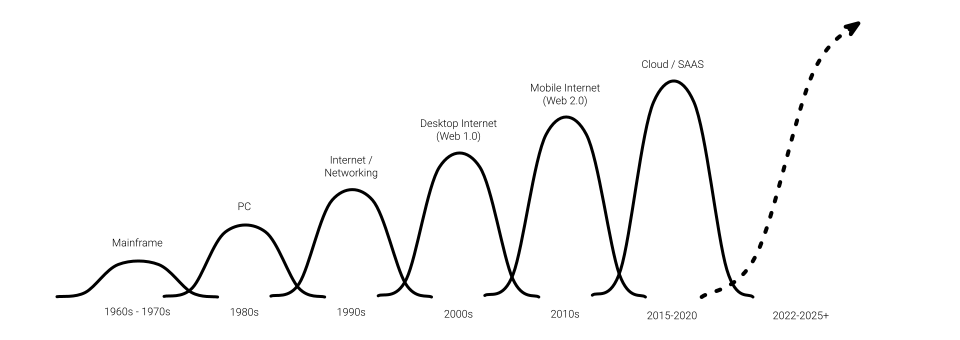
I read these technology waves as overlapping: each inherits infrastructure, operating practice, and distribution from earlier ones, then creates new complements of its own.
The diagram schematically represents waves of additional economic change. Earlier technologies remain part of the inherited infrastructure as their waves subside. Every curve is illustrative, including the solid AI segment; the dashed branches mark conditional future paths.
Three conditions would need to hold together:
- Useful capability becomes cheaper or more broadly applicable.
- Systems make that capability dependable enough to reuse.
- Organizations convert it into net value fast enough to sustain reinvestment.
The Flywheel is one possible mechanism: teams observe operation, evaluate what happened, retain what they learn, and test its effect. This supplies local evidence. A Supercycle requires those gains to transfer across workflows and institutions.
From capability to realized value#
The relevant unit is the deployed system:
- Capability determines what work can be attempted.
- Reliability and control determine how often it succeeds within constraints.
- Integration determines whether it can use the necessary data, tools, and identity surfaces.
- Operating controls and institutions provide evaluation, security, governance, monitoring, and human recourse.
Evidence should also be located by deployment state:
- access,
- individual use,
- workflow integration,
- scaled operation,
- and bounded autonomy.
These states describe use; Framing's evidence ladder describes the scope observed. Bounded autonomy can operate in a small workflow; scaled use can remain human-directed. Each can be studied with different scope and rigor.
Assess value at the level observed: task, person, organization, market, or society. Speed, outcome quality, distribution of benefits, and labor-market effects remain distinct questions, as the evidence note illustrates.
The cost boundary#
“AI is getting cheaper” can refer to several different things:
- the price of a unit of model capability,
- the total cost of a dependable outcome,
- or aggregate resource demand as use expands.
The first can fall while the other two rise. The economic sources document falling inference costs at a stated capability level and rising aggregate electricity demand. Whether lower prices stimulate enough additional use to raise total demand is an empirical question. Integration, evaluation, security, governance, supervision, and incident response can dominate dependable-outcome costs; their contribution requires workflow-level accounting.
For the Supercycle claim, compare the cost of dependable outcomes at a stated task mix, quality, error tolerance, and scope. More valuable work can justify higher cost. Count total cost and net value alongside cost per comparable outcome, including routine correction and exception handling. The people reviewing and repairing the work are part of its economics.
What could create compounding#
Several mechanisms could turn capability improvement into sustained diffusion:
- Conditional transfer: capability useful in one setting helps elsewhere when the tasks share enough structure, context, interfaces, and evaluation criteria.
- Reusable operating assets: tool interfaces, identity controls, policy layers, provenance, evaluation suites, and monitoring reduce the cost of the next deployment.
- Valid operating feedback: representative outcomes can be attributed, converted into system changes, and tested again.
- Organizational absorption: roles, incentives, training, and process change quickly enough to put capability into routine use.
- Reinvestment: realized gains fund further deployment, infrastructure, and complementary innovation.
Compounding requires these mechanisms to hold together. A deployment can generate observations while learning remains local. A reusable model can sit inside a bespoke system. If a team drafts proposals faster but every proposal still waits on an overloaded reviewer, the bottleneck has simply moved.
Bubble and Supercycle can coexist#
Markets can contain speculative excess and durable change at the same time. Expectations can outrun economics while useful systems continue to diffuse underneath them.
I would look at which deployments retain value after full costs, and which survive when capital, novelty, or pricing subsidies recede. The answer may differ by workflow, firm, and sector.
What would falsify this claim#
The Supercycle framing weakens if, over time:
- capability improves while costs for comparable dependable outcomes stay high enough to constrain wider use;
- reuse fails to reduce integration and control costs across deployments;
- broad experimentation does not progress to routine, scaled operation;
- hidden supervision and exception handling account for apparent performance;
- privacy, liability, security, or energy constraints prevent economically useful feedback or expansion;
- or net value fails to grow with added scope, or remains concentrated in narrow applications without durable second-order effects.
The strongest countercase is valuable bounded islands, with wider use blocked by context, permissions, reliability, or accountability. These applications could matter greatly to their users while forming separate waves with limited broader compounding.